


IKEA's 2025 Christmas Campaign

In today’s day and age, we are all so busy that even when we are physically present, we are rarely mentally there.
Most of us know this feeling, even if we don’t always acknowledge it. We sit together at the dinner table, spend evenings in the same room, and share space with the people we love, yet our attention is constantly pulled elsewhere. A phone lights up. A work message lingers in our mind. A moment passes while we are technically there, but not fully involved. Over time, this behaviour becomes normal. We stop noticing how often we half-listen or how rarely we give someone our full attention. And because it happens quietly, without conflict, it feels harmless. Still, it slowly chips away at the small moments that make relationships feel real.
It is this exact tension that IKEA chose to explore with its 2025 Christmas campaign. Instead of leaning into the usual festive noise, emotional music, and gift-heavy storytelling, IKEA Spain went in the opposite direction. They chose to focus on presence, on time, and on what it really means to be together at home. With the line “This Christmas, the best gift is being present,” the brand invited people to pause and consciously “Activate Home Mode.” Rather than telling people what to buy, IKEA asked them to notice how they show up and that is what we explore in this campaign analysis, just like we did with IKEA's Hidden Tags.
About IKEA’s 2025 “Activate Home Mode” Christmas Campaign
The campaign film centres on a young boy and his parents, shown inside their everyday home. Nothing about the setting feels dramatic or unusual. Meals are shared, routines continue, and the family is physically together. Yet as the film unfolds, it becomes clear that attention is often divided. Phones interrupt conversations, responses come late, and emotional cues are missed in small but meaningful ways.
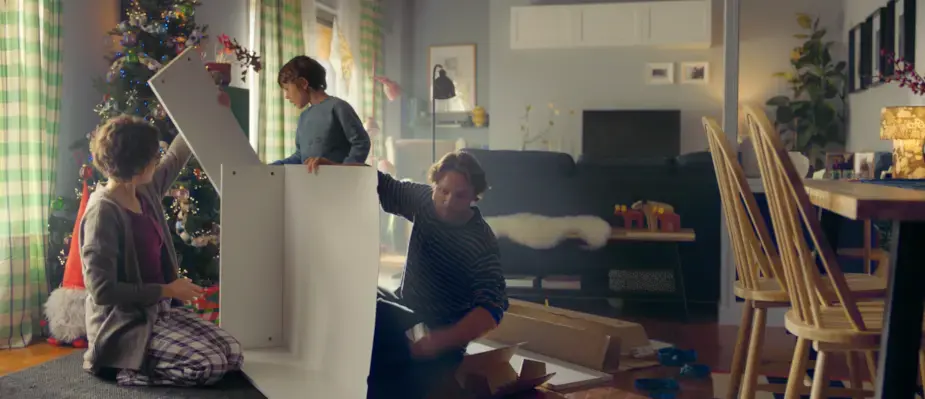
As Christmas approaches, the boy is asked to write his wish list. Instead of toys, games, or gadgets, he asks for an IKEA BILLY bookcase. At first, it feels like an odd choice, especially coming from a child. Slowly, however, the reason becomes clear. He knows that building it will require both parents to be involved, in the same space, at the same time. On Christmas morning, the flat-pack box is opened and placed on the floor. Instructions are spread out, tools are picked up, and phones are finally put aside. As the parents begin assembling the bookcase, something shifts. The pace slows. Conversations start flowing naturally. There is laughter, cooperation, and a sense of shared focus that had been missing before.
The film avoids exaggeration. There is no big emotional climax or heavy-handed message. Instead, it stays with quiet, familiar moments. Hands fitting pieces together. Small smiles exchanged across the room. A child watching his parents be fully present. Because of this restraint, the emotion feels earned rather than forced.
What Worked: Why This Campaign Feels So Relatable
What truly makes this campaign land is how closely it reflects real life. At the heart of this campaign analysis is a simple but powerful insight. People spend a large part of their day thinking about something other than what they are doing. Even at home, even during celebrations, our minds are often elsewhere. IKEA does not judge this behaviour or frame it as a failure. Instead, it quietly acknowledges it and invites people to do things differently, even if only for a moment.
The product choice strengthens this idea. The BILLY bookcase is familiar, affordable, and intentionally ordinary. It does not distract from the story. More importantly, it requires time and cooperation to build. In that moment, the product becomes a reason to slow down and connect, rather than something to consume quickly and move on from.
IKEA’s role in the story feels natural and honest. The home is positioned as the place where meaningful relationships are built, while IKEA products simply help create the conditions for those moments to happen. “Activate Home Mode” does not feel like a slogan trying to sell furniture. It feels like a reminder of something we already know but often forget.
What Could Have Been Better: Where the Idea Could Have Grown
As strong as the campaign is emotionally, it also feels like the beginning of something bigger. One clear opportunity lies in expanding the campaign globally. Presence, family, and togetherness are universal ideas. In markets like India, where festivals, shared meals, and family time are deeply rooted in culture, this message could have resonated even more strongly. With local stories and cultural context, IKEA could have extended the campaign’s emotional impact without changing its core idea.
Another area for growth is product storytelling. While the BILLY bookcase works beautifully as a symbol, IKEA has many products that require two or more people to build. Beds, dining tables, storage units, or even kitchen installations could have shown different forms of togetherness and different household dynamics. This would have added variety while reinforcing the same message around shared effort and time.
The campaign could also have moved beyond film into physical experiences. IKEA could have hosted workshops, in-store events, or community build sessions where families and friends come together to assemble products or even build Christmas trees and festive installations. Adding a light competitive or collaborative element would have turned bonding into an active experience rather than just an idea.
Finally, the campaign could have encouraged longer-term behaviour change. Simple prompts like screen-free evenings, shared build time challenges, or small home rituals tied to “Activate Home Mode” could have helped people carry the message beyond Christmas. This would have shifted the campaign from a seasonal reminder to a lasting habit.

My Take as a Marketing Student
What makes this campaign stand out to me is how confident it feels in its simplicity.
IKEA did not try to impress with scale, celebrities, or dramatic storytelling. Instead, it trusted a small human truth and allowed it to do the work. That restraint shows maturity, both creatively and strategically. It takes confidence for a global brand to slow things down during the busiest advertising season of the year.
From a student perspective, this campaign reinforces an important lesson. Strong marketing does not always come from louder ideas or bigger budgets. It comes from understanding people deeply and respecting their intelligence. IKEA does not tell the audience how to feel. It simply shows them something familiar and lets them connect the dots themselves. What I also appreciate is how clearly the product fits into the story. The BILLY bookcase is not presented as a hero object. It is ordinary, practical, and almost invisible. And that is exactly why it works. The value is not in the furniture itself, but in what it allows people to do together.
In this campaign analysis, IKEA reminds us that behaviour change does not always start with grand gestures. Sometimes it begins with small moments, like building something together on the living room floor and choosing, for once, to put your phone down. As someone studying marketing, this is the kind of work that stays with you. Not because it is flashy, but because it feels true. It shows that when strategy, insight, and emotion align, a brand can create something that genuinely matters.
Campaign Scorecard
Element | Score (Out of 10) |
Concept and Originality | 9.8 |
Strategic Relevance | 9.4 |
Emotional Impact | 9.5 |
Visual Storytelling | 8.9 |
Brand Integration | 8.7 |
Overall Score | 9.3 |
Final Thoughts
In a season usually filled with noise, urgency, and excess, IKEA chose to slow things down.
The campaign does not ask people to buy more or do more. It simply asks them to be more present. To put devices aside, share time, and show up for the people they are already with.
And in a world where attention is constantly divided, IKEA reminds us that presence may be the most meaningful gift we can give.
Found this analysis insightful? Check out my strategic breakdown on Tinder's Ex-press Disposal Truck Campaign.
~ Siddh
Breaking down campaigns one story at a time.
TL;DR - Campaign Snapshot
Campaign Name: Activate Home Mode
Brand: IKEA
Market: Spain
Industry: Home & Furniture Retail
Campaign Type: Integrated Christmas brand campaign
Launch Period: November 2025
Core Idea:Position presence and quality time as the most meaningful Christmas gift, encouraging people to disconnect from screens and reconnect at home.
What Worked:Emotionally grounded storytelling, strong cultural insight, and smart use of an everyday IKEA product to represent togetherness.
What Could Have Been Better:Greater global rollout, more participatory experiences, and clearer ways for audiences to act on the message beyond the film.
Student Take:A thoughtful reminder that strong campaigns do not need to shout. With more interaction, this idea could evolve from a message into a movement.
Overall Score: 9.3/10


Mình coi xổ số kiểu cho vui là chính, giải trí chút thôi nên không đặt nặng chuyện phải trúng hay không. Trước đây nghe nhiều người bàn về “cầu” với đủ kiểu dự đoán, mình cũng tò mò thử theo dõi xem có gì hay. Một thời gian thì thấy đôi lúc có vài dạng lặp lại, nên mỗi lần đọc nhận định mình hay ghi lại vài ý ngắn rồi chờ kết quả để đối chiếu, coi mình có bị cảm tính quá không. Có hôm trúng được chút thì cũng vui, nhưng nhiều bữa lệch hẳn nên mình tự nhắc là đừng tin tuyệt đối, nhất là chuyện tiền bạc và tâm lý phải tự kiểm soát.…